
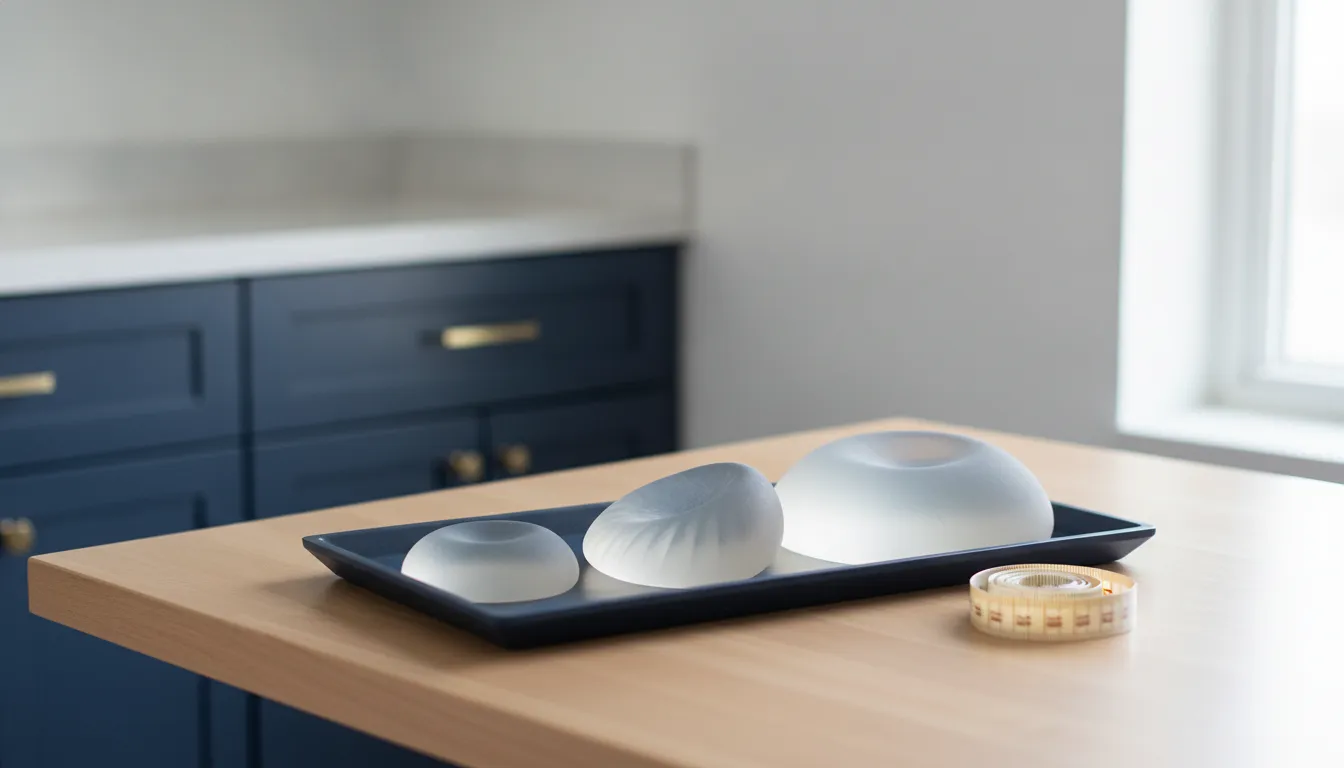
Choosing breast augmentation surgery starts with a size that fits your chest, not a single cup letter.
Breast augmentation implant sizes are not one number you pick from a chart. Volume, profile, and the width of your chest all change how the same implant looks on you. At North Star Plastic Surgery in Fairbanks, Dr. Erick G. Martell, M.D. matches those measurements to your frame during a consultation, rather than starting from a cup size.
Call (907) 415-1884 to plan breast augmentation surgery
What Breast Augmentation Implant Sizes Actually Measure
Implant volume is listed in cubic centimeters, often shortened to cc. A higher cc means more fill, not a guaranteed cup size. Bra sizing changes by brand, and your own tissue already takes up space, so two people with the same implant can land in different cups.
Profile is how far the implant projects from the chest for a given width. A low profile spreads the volume. A high profile puts more of that volume forward. Base width is the diameter across the implant. It has to sit inside the width of your breast, not past the side of your chest or into the center.
North Star Plastic Surgery offers saline and silicone implants, placed above or below the chest muscle, and also discusses fat transfer when that fits the goal. The fill and the shell change feel and incision needs. They do not replace the width and profile decision. The FDA's overview of breast implant types is the reference Dr. Martell uses when he reviews age guidance and the fact that implants are not lifetime devices.
Most primary augmentation samples fall in a broad band, often discussed from the low 200s into the 600s and beyond. That range is a catalog, not a recommendation. A patient with a narrow chest and limited tissue may never be a candidate for the upper end, even if a photo made that volume look modest on someone else. Dr. Martell will tell you when a requested volume sits outside what your base width can hold.
Round implants are the samples most patients compare first. Shaped implants exist in some product lines, but the fit question is the same. Width comes first, then projection, then the cc those two choices produce. Smooth shells are the common discussion for a primary augmentation at this practice. Texture is a separate device question, not a shortcut to a bigger look.
How Volume, Profile, and Width Work Together
Think of the implant as three linked choices. Change one, and the others move.
| Choice | What it changes | A common mismatch |
|---|---|---|
| Volume (cc). | How much fill is added. | A large cc on a narrow chest can look round or sit too far to the side. |
| Profile. | How much of that fill projects forward. | A low profile can look wide and flat if you wanted upper fullness. |
| Base width. | How wide the implant is across the chest. | A base wider than your breast can show at the edges. |
| Your tissue. | How much of the implant is covered. | Thin coverage can show rippling even at a modest size. |
A moderate volume with a higher profile can look fuller than a larger volume with a low profile, because more of the fill sits forward. That is why a photo of someone else's result is a starting point, not a size order. Bring photos if they help you describe a look, then let the measurements decide what is realistic on your chest.
Here is a simple way to picture it. Hold the base width still. Raise the profile, and the implant gets taller from front to back while the cc often rises with it. Drop the profile, and the same width looks flatter. You would then need more width, not just more cc, to copy the fullness you see in a photo. Patients who say they want to go up one cup are usually describing projection. The exam turns that request into a width and a profile the chest can support.
Asymmetry changes the math. One breast is often slightly wider or sits a little lower. Using one cc on both sides can leave that difference in place, or it can make it easier to see. Dr. Martell may suggest two volumes inside the same profile family so the result looks closer, not so the chart is symmetrical. The goal is balance in clothing and in the mirror, not identical numbers on a label.
The existing guide to augmentation options and costs covers fill type, risks, recovery, and pricing. This page stays on the size decision those sections only mention.
What Dr. Martell Measures Before Suggesting a Size
At a visit in Fairbanks, the exam is what sets the range. Dr. Martell looks at the width of each breast, the space between them, how much skin and tissue you have, and whether one side sits differently from the other. Nipple position and skin stretch matter too, because an implant adds volume but does not lift a low nipple on its own.
He also asks what you want the result to do. Some patients want to restore volume after pregnancy or weight change. Others want more balance between the two sides, or a modest increase that still looks like their frame. Those goals point to different parts of the same size chart.
You can try sizers in a bra during planning so the number is tied to a look, not only a label. Sizers are a guide. Swelling, implant position, and how the implant settles will still change the early result. Expect the conversation to cover placement above or below the muscle, because that choice changes how much of the implant you see at the top of the breast.
Placement is part of sizing even though it is not a cc. Under the muscle, the muscle covers the upper part of the implant, which can soften the edge on a patient with thinner tissue. Over the muscle, more of the implant shows. Some patients want that when they are restoring upper fullness. Neither placement makes an oversized base width fit. If the base is too wide, changing the pocket will not hide it.
Incision choice can also limit the implant you try on paper. A very cohesive gel implant may need a slightly longer opening than a saline implant that is filled after it is placed. That is a planning detail, not a reason to pick a size your chest cannot cover. Dr. Martell will say when a requested volume and a preferred scar location do not go together.
If you are still gathering questions, the consultation prep guide walks through what to bring. Size selection is one part of that visit, not the whole visit.
How to Compare Profiles Without Chasing a Cup Size
Use the steps below when you look at samples. They keep the talk on fit instead of a single cup letter.
- Start with base width. The implant should fit the width of your breast.
- Pick a profile that matches the forward fullness you want inside that width.
- Read the cc as the volume that profile holds, not as a bra size.
- Check both sides. A small difference in width may call for two different volumes.
- Ask how your tissue will cover the edges, especially if you are choosing a larger size.
- Look at long-term plans, including pregnancy, weight change, and whether a lift may be part of the plan.
Low and moderate profiles suit patients who want a softer slope and have enough width to hold the implant. Higher profiles suit a narrower chest when the goal is more projection without a wider base. There is no best profile. There is a profile that fits the measurement and the look you described.
Try the comparison in clothes you already own. A fitted top for work, a winter base layer, and a blouse you wear often will tell you more than a mirror in a gown. If the sizer looks right only when you stand still and looks heavy when you lean forward, say so. That feedback is more useful than adding a small step in cc because the next card looked close.
Small steps on a manufacturer card are not small on every frame. Moving from one volume to the next can be a short jump in cc, and on a narrow chest that jump is easy to see. On a broader chest the same jump can be hard to notice. This is another reason North Star Plastic Surgery does not publish a one-size recommendation. The step that matters is the one your width and tissue can absorb.
If sagging is the main concern, a larger implant will not take the place of a lift. The breast lift versus breast augmentation page explains that difference, and the breast lift page covers the lift itself. Some patients plan both. That is a separate decision from which cc to choose.
What a Larger or Smaller Size Changes Day to Day
Size is also a lifestyle choice. A larger implant can mean more early tightness, a longer time in a support bra, and more attention to high-impact exercise while you heal. A smaller implant can look quieter in fitted clothing and may be easier to pair with an active routine in Interior Alaska, where winter layers already add bulk.
Clothing is a useful test. Think about the tops, workwear, and outdoor layers you actually wear in Fairbanks, not only a photo taken somewhere else. Patients who drive in from nearby Interior communities should also think about follow-up visits, because the early weeks are when Dr. Martell checks position and swelling.
Work and season matter in this part of Alaska. A patient who lifts patients, children, or gear at work may prefer a volume that does not fight a support bra during long shifts. A patient whose priority is clothing fit after pregnancy may accept more early tightness for a different profile. Neither choice is more correct. Both should be said out loud before a size is written into the plan.
Weight stability belongs in the same talk. A large gain or loss after surgery changes how an implant looks, because your tissue changes around a device that does not. If your weight is still moving, Dr. Martell may suggest waiting so the size you choose still fits later. That pause is part of planning, not a refusal.
The FDA notes that the longer someone has implants, the more likely they are to need surgery to remove or replace them. Choosing a size you can live with matters more than matching a trend. Capsular contracture, rupture, rippling, and the need for another operation are part of that long view, and they belong in the same conversation as the cc number.
Saline implants are FDA-approved for augmentation at age 18 or older. Silicone gel implants are approved for augmentation at age 22 or older. Reconstruction follows different age guidance. If age or a prior implant is part of your history, say so at the visit so the options stay inside what is appropriate for you.
How North Star Plastic Surgery Plans the Result in Fairbanks
North Star Plastic Surgery is at 562 University Ave, suite 101, Fairbanks, AK 99709. Office hours are Monday through Wednesday and Friday, 8 am to 12 pm and 1 pm to 4 pm. Dr. Martell is a double board certified plastic surgeon. His training includes general surgery and plastic and reconstructive surgery, and the practice focuses on the procedure in front of you, not a catalog of looks.
Breast care here also includes breast procedures such as breast lift, breast reduction, and breast reconstruction. Augmentation for shape and volume is not the same operation as reconstruction after mastectomy. If you are comparing those paths, ask which one matches your history before you talk about implant samples.
Patients who want a local overview of surgeon choice, travel, and what a Fairbanks plan includes can read the Fairbanks breast augmentation guide. This article does not repeat that plan. It stays on how size, profile, and width are chosen.
A written quote covers the surgery you and Dr. Martell agree on, including the implant that fits the measurements. Financing questions belong on the financing page, not in a size chart. Cosmetic augmentation is planned as a self-pay procedure unless a separate medical review says otherwise, and that review is not a promise of coverage.
Call (907) 415-1884 to review implant sizes in person
Frequently Asked Questions
Does a higher cc mean a bigger cup size?
Not by itself. Cup size depends on your chest, the bra brand, and the tissue you already have. Two patients can wear the same implant volume and not share a cup size. Dr. Martell uses chest width, profile, and sizers so the plan is tied to your frame.
What is the difference between implant profile and implant size?
Size, in cc, is the volume. Profile is the shape of that volume: how much projects forward versus how wide the base is. A high profile can look fuller on a narrow chest without using a wider implant. The right pair is the one that fits your breast width and the look you described.
Can I choose a size from a friend's result or an online photo?
Photos help you describe a direction. They do not transfer. Base width, skin stretch, and tissue thickness decide what will look natural on you. Bring the photos to North Star Plastic Surgery and use them as a reference during sizing, not as an order.
Will a larger implant fix sagging?
No. An implant adds volume. It does not raise a nipple that sits low or remove extra skin. If sagging is the main issue, ask about a breast lift, alone or with an implant. That choice is separate from the cc and profile discussion.
How do I start if I am still unsure of a size?
Book a consultation and plan to try sizers after the exam. You do not need a final number before you call. The phone at North Star Plastic Surgery is (907) 415-1884, and you can also send a message through the contact page.
This article is educational and is not medical advice. Whether a procedure is right for you is decided through an evaluation with the practice.